Monday, May 10, 2010

Artist Study * Mini-Research Paper

For this paper, you will find a ceramic artist whose work you are particularly drawn to…look online, in books or magazines for inspiration. The artist can be contemporary, meaning they are alive and creating ceramic art today, or they can be from any point in history.

Print out or photocopy at least two images of your chosen artist’s work. These photos will be passed in with your paper.

The paper will be a summary of the artist’s bio as well as why you chose them and what specifically you admire about their work. This should be about 1 page: make sure you include all the information below!

-who the artist is

-important dates: birth, death (if applicable), when they were creating artwork

-where they are from, where they work(ed)

-what specific techniques do they use? types of clay/glazes, type of kiln/firing process

*hint: when you see a word you do not recognize, ex. “raku”, look it up in Google or Wikipedia and describe that in your paper!

-why you chose this artist: what drew you to their work? why do you admire this person, what about your knowledge of ceramics makes them particularly interesting?

-what connections can you make between this person’s work and your own ceramic work? are the two similar in style, concept, form or finish? or are they very different—and how did the similarities/differences influence your decision to choose this artist in particular?

Please use complete sentences, and type the paper….remember that the content is more important than the length of the paper!

*Due Friday, May 21st*

Monday, April 26, 2010

Luminary: a body that gives light, especially one of the celestial bodies (Merriam-Webster’s online dictionary)

Our ceramic luminaries will be box forms that enclose a candle, have a lid, and let out light through a series of pierced decorations.

Create a challenging geometric form with your slabs. Make a paper template before beginning. Control dry slabs to leather hard, bevel edges and slip and score well!

Use piercing in a thoughtful and meaningful manner: piercing should enhance and fit with the overall theme.

Use a color scheme with surface decoration that is well chosen and well applied.

Optional: tie the visual theme of your luminary to a dream (which could have occurred during sleep, or may be a wish or want while awake)

Homework due Friday, April 30th (or before for extra credit!)

Sketch out your idea for the luminary on the back of this sheet

Also--go to www.begceramics.blogspot.com to check out pictures of luminaries, and leave a comment for extra credit!

check minus=late, on time but not in color or rushed

check=on time, in color, thoughtfully drawn

check plus=early, more than one sketch, in color, description included

Wednesday, April 7, 2010

Visual Pathways

There are many ways to create interesting visual pathways on your project using surface design. The goal in coming up with a surface design is to create interest all around your three-dimensional piece. Leading lines are lines in a design that lead the viewer’s eye around the piece…try diagonals, or flowing, sweeping lines that carry the design from one side of the piece to the other.

Will you follow the symmetry of the form,

or will your design be asymmetrical?

How will you use surface design to give the

viewer clues about your culture

or personal interests?

Wednesday, March 24, 2010

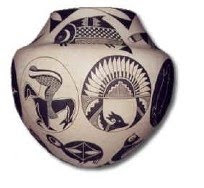
Coil Challenge The coil technique was developed as a means of creating larger, symmetrical forms without using a wheel. Often coils are added to a wheel-thrown form to add to its existing height. Coils can be used to create complex or simple shapes that may be difficult or impossible to create on a wheel.

Ancient cultures used coils to create everyday wares, such as cooking pots, garden pots, perfume or oil jars. Many cultures also created forms used specifically for celebrations or rituals, like a serving dish for a feast, a musical instrument, or a funerary urn. The surface decoration on the pottery tells a story of the culture it came from.

If your coil pot was found 100 years from now, how would it represent your culture? How will you use surface decoration to enhance the overall form of your pot, as well as incorporate modern patterns and imagery into your project?

Create a coiled form focusing on symmetry and balance: focus on craftsmanship and neatness as well

Decorate the surface using sgraffito or the coils themselves: create a surface that tells a story or shares something with the viewer

Focus on excellent studio habits: showing up on time, working throughout each class, doing studio jobs thoroughly

Design your coil pot below. Create a sketch of the form of your coil pot, then color in the surface showing how you will decorate the form.

Sketches due Monday 3/29

Monday, January 4, 2010

Artist Study * Mini-Research PapeR

For this paper, you will find a ceramic artist whose work you are particularly drawn to…look online, in books or magazines for inspiration. The artist can be contemporary, meaning they are alive and creating ceramic art today, or they can be from any point in history.

Print out or photocopy at least two images of your chosen artist’s work. These photos will be passed in with your paper.

The paper will be a summary of the artist’s bio as well as why you chose them and what specifically you admire about their work. This should be about 2 pages: make sure you include all the information below!

-who the artist is

-important dates: birth, death (if applicable), when they were creating artwork

-where they are from, where they work(ed)

-what specific techniques do they use? types of clay/glazes, type of kiln/firing process

*hint: when you see a word you do not recognize, ex. “raku”, look it up in Google or Wikipedia and describe that in your paper!

-why you chose this artist: what drew you to their work? why do you admire this person, what about your knowledge of ceramics makes them particularly interesting?

-what connections can you make between this person’s work and your own ceramic work? are the two similar in style, concept, form or finish? or are they very different—and how did the similarities/differences influence your decision to choose this artist in particular?

Please use complete sentences, and type the paper….remember that the content is more important than the length of the paper!

*Due Friday, January 15th* *Please include Sources!*

Monday, November 30, 2009

Luminary: a body that gives light, especially one of the celestial bodies (Merriam-Webster’s online dictionary)

Our ceramic luminaries will be box forms that enclose a candle, have a lid, and let out light through a series of pierced decorations.

Create a challenging geometric form with your slabs. Make a paper template before beginning. Control dry slabs to leather hard, bevel edges and slip and score well!

Use piercing in a thoughtful and meaningful manner: piercing should enhance and fit with the overall theme.

Use a color scheme with surface decoration that is well chosen and well applied.

Optional: tie the visual theme of your luminary to a dream (which could have occurred during sleep, or may be a wish or want while awake)

Homework due Friday, December 4th (or before for extra credit!) Sketch out your idea for the luminary on the back of this sheet

check minus=late, on time but not in color or rushed

check=on time, in color, thoughtfully drawn

check plus=early, more than one sketch, in color, description included

Tuesday, October 13, 2009

Homework Assignments due for 1st term:

Week of 9/14: Come up with a list of 10 words and their definitions in preparation for the Cup and Saucer project. Try to choose a word to base tour cup and saucer around.

Week of 9/28: Create a Color Collage in preparation for the color tile project. Use at lease 3 different materials (ex: colored pencil, marker, wrapping paper, tissue paper, paint, magazine...) to create a picture or abstract design on an 8 1/2 x 11" piece of paper.